Presentation
Presentation
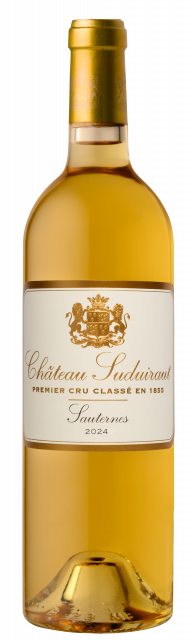
Château Suduiraut, classed as a Premier Cru in 1855, is made from grapes selected from the finest terroirs of the property.
This wine is hand crafted at every stage of its elaboration and reveals remarkable finesse and complexity and a golden colour reminiscent of the sun that made it possible. With age the bright gold evolves to a dark amber colour. With an extensive life-span, it powerfully and harmoniously combines fruit and floral aromas with roasted and candied notes.
This wine is hand crafted at every stage of its elaboration and reveals remarkable finesse and complexity and a golden colour reminiscent of the sun that made it possible. With age the bright gold evolves to a dark amber colour. With an extensive life-span, it powerfully and harmoniously combines fruit and floral aromas with roasted and candied notes.
The vintage
- Heavy rainfall in the late autumn and winter 2023/2024.
- A very wet start to the year with mild temperatures.
- Late March: budburst 10 days earlier than usual.
- April and May: temperatures dropped, slowing down vine growth. May was still very rainy, which unfortunately led to the development of mildew and difficult flowering, with some plots suffering from coulure, fortunately offset by generous bunch emergence.
- June-July: due to hot, very dry weather over the summer, mildew was overcome and the vigour of the vines was kept in check. A good start to ripening.
- Early August: veraison began in normal conditions.
- A very wet start to the year with mild temperatures.
- Late March: budburst 10 days earlier than usual.
- April and May: temperatures dropped, slowing down vine growth. May was still very rainy, which unfortunately led to the development of mildew and difficult flowering, with some plots suffering from coulure, fortunately offset by generous bunch emergence.
- June-July: due to hot, very dry weather over the summer, mildew was overcome and the vigour of the vines was kept in check. A good start to ripening.
- Early August: veraison began in normal conditions.
Harvest
The harvest for the vin liquoreux took place between 19th September and 24th October with a total of 4 selective pickings.
- Rain in early September, followed by sunny, windy weather, triggered the rapid and consistent development of Botrytis.
- The first selective picking went fairly quickly, starting on 19th September and ending on 25th September with 5 batches and 158 hectolitres.
- Rain at the end of September forced us to take a 6-day break before resuming harvesting.
- 2nd October: with improved weather, we were able to start the second selective picking, interrupted on the 5th by a few days of rain.
- 11th October: continuation and end of this second picking. With greater richness, it resulted in 9 batches, representing 236 hectolitres.
- Two days of hot, windy weather reconcentrated the grapes.
- From 14th to 17th October: third selective picking. Sorting became increasingly demanding to ensure the purity of the musts. This picking lasted 4 days, with 6 batches totalling 156 hectolitres.
- 23rd and 24th October: fourth and final selective picking of 25 hectolitres.
- The yield was 11.3 hectolitres per hectare for the Sauternes.
65% of production is destined for dry wines and 35% for the vin liquoreux.
- Rain in early September, followed by sunny, windy weather, triggered the rapid and consistent development of Botrytis.
- The first selective picking went fairly quickly, starting on 19th September and ending on 25th September with 5 batches and 158 hectolitres.
- Rain at the end of September forced us to take a 6-day break before resuming harvesting.
- 2nd October: with improved weather, we were able to start the second selective picking, interrupted on the 5th by a few days of rain.
- 11th October: continuation and end of this second picking. With greater richness, it resulted in 9 batches, representing 236 hectolitres.
- Two days of hot, windy weather reconcentrated the grapes.
- From 14th to 17th October: third selective picking. Sorting became increasingly demanding to ensure the purity of the musts. This picking lasted 4 days, with 6 batches totalling 156 hectolitres.
- 23rd and 24th October: fourth and final selective picking of 25 hectolitres.
- The yield was 11.3 hectolitres per hectare for the Sauternes.
65% of production is destined for dry wines and 35% for the vin liquoreux.
Winemaking
- Gentle and long pneumatic pressing: about 3 hours,
- Then vertical pressing: about 50 minutes to extract the most concentrated part,
- Cold settling at 10°C,
- Alcoholic fermentation with indigenous yeasts in French oak barrels, 50 % of which are new, for 2 to 3 weeks,
- Cooling the wine to stop fermentation and sulphiting.
- Then vertical pressing: about 50 minutes to extract the most concentrated part,
- Cold settling at 10°C,
- Alcoholic fermentation with indigenous yeasts in French oak barrels, 50 % of which are new, for 2 to 3 weeks,
- Cooling the wine to stop fermentation and sulphiting.
Ageing
50% in new barrels,
50% from barrels of one vintage, for 16 to 20 months, according to the evolution of the wine.
50% from barrels of one vintage, for 16 to 20 months, according to the evolution of the wine.
Varietal
Sémillon : 100%
Specifications
Alcohol content : 13.9 % vol.
Residual Sugar : 130 g/l
pH : 3.83
Total acidity : 4.1 g/l